Industrial dust and dry fumes filtration tower
AirTREAT Tower
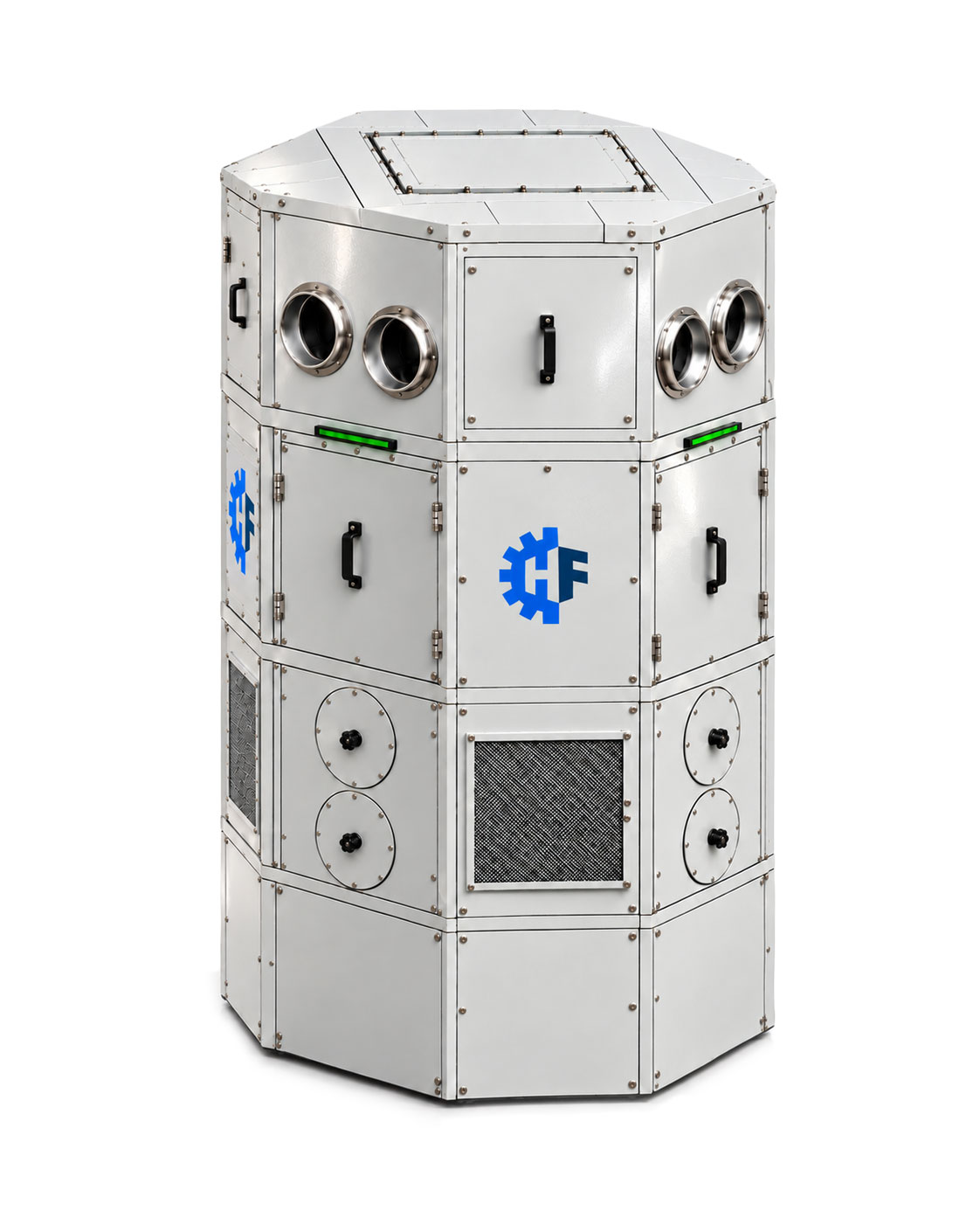
In large industrial halls, dust, dry fumes and airborne particulate matter tend to spread throughout the production area, particularly where local extraction of contaminants is difficult, insufficient or impractical. AirTREAT Tower is a dust and dry fumes filtration tower designed to improve air quality in these environments.
By treating large volumes of air directly within the facility, AirTREAT Tower reduces the amount of airborne contaminants and limits dust deposits on machinery, electrical panels and other components in the production area.
In the dust and dry fumes configuration, the primary filtration stage is selected according to the contaminant to be treated and is followed by a final HEPA H13 absolute filtration stage.
How AirTREAT Tower works for dust and dry fumes
Inside the filtration tower, three integrated modules operate in sequence: capture and filtration, ventilation, and air diffusion.
1. Capture and filtration
Air containing dust, dry fumes and particulate matter is drawn in through the capture points integrated into the tower and directed towards the dedicated filtration section.
The primary filtration stage can be configured with different filter media depending on the application: polyester, antistatic polyester for specific dust applications, or a polyester-cellulose blend, for example for welding fume applications. For dust applications, the system can also be configured with self-cleaning cartridges.
The separated dust is collected in a dedicated container located at the bottom of the unit.
2. Ventilation
By moving large volumes of air, the integrated fan unit promotes continuous air recirculation throughout large production areas.
3. Air diffusion and destratification
The upper air diffusion system returns the filtered air to the production area, promoting controlled air recirculation. The resulting airflow can also contribute to air destratification and help create more uniform conditions at different heights within the industrial building.
How are dust and dry fumes filtered?
High-efficiency primary filtration for dust and dry fumes
The first filtration stage captures dust, dry fumes and particulate matter present in the extracted air. The filter media are selected according to the characteristics of the contaminant and the process, allowing AirTREAT Tower to be configured for the specific application.
Final HEPA H13 absolute filtration stage
After the primary filtration stage, the air passes through a final HEPA H13 absolute filtration stage, included as standard in the AirTREAT Tower configuration. The combination of the two filtration stages enables the system to achieve an overall efficiency of up to 99.99%.
Intelligent dust and dry fumes treatment for large production areas
Even where local extraction systems are installed, dust and dry fumes in large industrial halls can move away from the source and remain suspended in the air for long periods.
AirTREAT Tower acts on the air volume of the entire production environment and is particularly suitable for diffuse sources, mobile workstations, large workpieces or layouts where ducting every emission point would be complex.
Capture, filtration, ventilation and air diffusion are managed within a single stand-alone system. The airflow rate is automatically modulated according to the conditions in the production area, allowing the system to adapt to actual operating needs and reduce energy consumption compared with constant operation at maximum power, without requiring continuous manual adjustments.
Range
AirTREAT Tower 12 - Dust & dry fumes
Airflow: Up to 12.000 m³/h. For dust, dry fumes and diffuse particulate matter.
AirTREAT Tower 24 - Dust & dry fumes
Airflow: Up to 24.000 m³/h For production areas requiring higher airflow rates.
APPLICATIONS
- Sharpening
- Boring
- Aluminum and zinc
- Other applications
- Hazardous environments
- Agricultural operations
- Broaching
- VOC
- Drying
- Threading and tapping
- Bag filter
- Square filter
- Filter
- Drilling
- Milling
- Dry fumes and dust
- Shot blasting
- Laser cutting
- Chemical analysis laboratories
- Food processing
- Electroplating
- Marble processing
- Food oil processing
- CNC machining
- Lathe machining
- Various machining processes
- Sanding
- Metal cleaning machines
- Oily mists
- Emulsion atomization
- Neat oil atomization
- Shot peening
- Dust with sparks
- Presence of oil
- Die casting
- Asphalt/bitumen production
- Cosmetics production
- Metal cleaning
- Cleaning
- Grinding and superfinishing
- Metal salting
- Grinding and deburring
- Storage
- Saw cutting
- Cutting
- Mixing and weighing of powdery solid materials
- Steel industry
- Heat treatments
- Painting
- Glassware
- Machining on machine tools
- Chemical processes
- Cement
- Pharmaceutical processing
- Carbon
- Plastics processing
- Welding
- Plasma cutting
- Epoxy coatings
- Grinding
- Wenting silos
- Sandblasting
- Deburring
- Cardiac System
- Respiratory System
- Combustion
- Dentition
- Volcanic Eruptions
- Milling-153
- Metal materials fusion
- Incineration plants
- Paper industry
- Processes with odorous emissions
- Processes with graphite
- Processes with combustible powders
- Woodworking
- Pickling lines
- Metal washing machines-139
- Small metal parts
- Leather
- Eye problems
- Passivation process
- Feed production
- Adhesive tape production
- Abrasive products production
- Superfinishing grinding
- Grinding
- Satin finishing
- Metal satin finishing
- Nervous System
- Waste disposal
- Colis-calamina leveling
- Storage, handling, and pneumatic transport of powdery solid materials
- Storage and handling of powdery solid materials
- Waste storage
- Thermal cutting
- Heat Treatments and Finishing Processes
- Wastewater treatment
- Paints and solvents
- Foundries
- Hot/cold stamping
- Rubber industry
- Industrial frying
- Configurable filter media according to the type of dust or dry fumes, with self-cleaning cartridges for dust applications.
- Final HEPA H13 absolute filtration stage included as standard, with an overall system efficiency of up to 99.99%.
- Reduction of dust, dry fumes and airborne particulate matter in the working environment and in the air breathed by operators.
- Reduced dust deposits on machinery, electrical panels and electronic components.
- Effective treatment of airborne contaminants, even when they are dispersed throughout the production area.
- Treatment of large volumes of air with a stand-alone plug & play system, no ductwork required.
- Fixed installation or relocation according to the production hall layout.
- Automatic modulating airflow, no continuous manual intervention, with reduced energy consumption and lower maintenance costs.
Versions
Request the brochure
Fill out now our form below to receive the brochure. Fields marked with an asterisk are mandatory!
Tell us your needs
Fill out our form below and you will be contacted by one of our experts as soon as possible! You will have the opportunity to share all your needs. Fields marked with an asterisk are mandatory!

Here your clicks weigh less on the environment. We are using the Xpeis® technology that optimizes the energy expenditure to make this site work and the server that hosts it.